PYTHON TRAINING IN HYDERABAD
Become a Job-Ready Python Developer
Master programming fundamentals, build production-grade web applications & automation scripts, and prepare for high-growth tech careers with AIDEAS Academy.
Get the complete syllabus + batch details + fee information
Our Alumini Work At


















Why Learn Python in 2026?
Don't Learn Just Syntax. Learn How to Build Complete Applications.
Knowing Python syntax is only the beginning.
Companies need developers who can write clean object-oriented code, manage relational databases, design REST APIs, automate workflows, and deploy modern applications.
Our Python program takes you step-by-step from zero programming background to building production web services and AI-integrated applications.
Clean OOP + Relational databases + REST APIs + Production web services + AI integrations.
Industry Standard Tools & Technologies

Python 3.12
Build a strong programming foundation with clean OOP, data structures, and idioms.

Django Framework
Develop scalable backend applications with robust ORM, security, and authentication.

PostgreSQL & SQL
Master database design, relational queries, joins, indexes, and ACID transactions.

REST APIs & Postman
Architect, test, and document secure REST endpoints using Django REST Framework.

Web Scraping
Extract web intelligence with BeautifulSoup, Requests, and automated data pipelines.

Git & GitHub
Collaborate professionally using feature branches, pull requests, and Git workflows.

Docker Containers
Package Python applications for consistent, isolated deployments across environments.

Generative AI APIs
Integrate LLM APIs (OpenAI, Gemini) for automated summaries, chatbots, and AI agents.
Want to See the Complete Roadmap?
Get the Comprehensive Python Developer Syllabus & Class Schedule
13 Modules: From Python Zero to Production Ready
- Introduction to SDLC and its importance in software development
- Phases of SDLC: Requirement gathering and analysis
- Phases of SDLC: System design and architectural patterns
- Phases of SDLC: Development and coding standards
- Phases of SDLC: Testing and quality assurance
- Phases of SDLC: Deployment and release management
- Phases of SDLC: Maintenance and monitoring
- Common SDLC models: Waterfall model
- Common SDLC models: Agile and Scrum framework
- Sprint planning, daily standups, and retrospectives
- DevOps lifecycle basics: CI/CD overview
- Comparison of traditional vs modern agile software engineering
- Waterfall methodology overview and use-cases
- Agile principles, 12 manifesto values
- Scrum roles: Product Owner, Scrum Master, Developer
- Kanban boards and WIP limits
- Continuous integration and continuous delivery concepts
- Version control and collaborative Git branching models
- Business Analyst & requirement elicitation
- UI/UX Designer handoff and asset workflow
- Backend Developer role: APIs, databases, logic
- Full Stack Developer role: End-to-end delivery
- QA & Automation Engineer testing pipeline
- DevOps Engineer & cloud infrastructure
- Project Manager & Delivery Lead expectations
- Overview of Python, philosophy and history
- Python features: interpreted, dynamic, multi-paradigm
- Installation of Python 3.12, PATH setup, IDE configuration
- Python execution flow: Bytecode and Python Virtual Machine (PVM)
- Writing and executing your first Python script
- Variables, dynamic typing, and memory references
- Keywords, identifiers, and naming conventions (PEP 8)
- Standard data types: int, float, str, bool, None
- Operators: Arithmetic, Relational, Logical, Bitwise, Identity, Membership
- Standard input (input()) and output (print()) formatting with f-strings
- Conditional branching: if, elif, else, and nested conditions
- Looping constructs: while loop and for loop with range()
- Jump statements: break, continue, pass
- Loop else clauses and common loop idioms
- Writing iterative algorithms and pattern programs
- Lists: Indexing, slicing, mutable operations, list methods
- Tuples: Immutability, tuple packing and unpacking
- Sets: Set theory operations (union, intersection, difference), frozensets
- Dictionaries: Key-value mapping, dict methods, hash table internals
- List comprehensions with conditions
- Dictionary and Set comprehensions
- Nested data structures (list of dicts, nested mappings)
- Sorting complex structures with key functions and lambda
- Time and space complexity comparison across Python data structures
- Function definition (def), parameters, and return statements
- Positional, keyword, default, and variable-length arguments (*args, **kwargs)
- Scope resolution: LEGB rule (Local, Enclosing, Global, Built-in)
- Anonymous functions: lambda expressions, map(), filter(), reduce()
- Closures and higher-order functions
- Creating custom Python modules and importing strategies
- Understanding __name__ == '__main__'
- Building packages with __init__.py
- Python Standard Library essentials: math, random, datetime, os, sys, json
- Virtual environments (venv, pip) and requirements.txt management
- Object-Oriented paradigm vs procedural programming
- Defining classes, instantiating objects
- Constructors: __init__() and instance initialization
- Instance variables vs class (static) variables
- Instance methods, class methods (@classmethod), static methods (@staticmethod)
- Encapsulation: Public, protected (_), and private (__) attributes
- Inheritance: Single, multiple, multilevel, and Method Resolution Order (MRO)
- Polymorphism: Method overriding and operator overloading with dunder methods
- Abstraction: Abstract Base Classes (ABC) and @abstractmethod
- Properties: @property getter, setter, and deleter decorators
- Errors vs Exceptions hierarchy (BaseException, Exception)
- Handling runtime errors: try, except, else, finally blocks
- Handling multiple exceptions and exception chaining
- Raising exceptions manually with raise
- Creating custom user-defined exception classes
- File access modes: r, w, a, r+, w+, b
- Context managers and the with statement for safe file closure
- Reading and writing text files line-by-line
- Parsing and creating CSV files with the csv module
- Serializing and deserializing data with the json module
- Relational database concepts (RDBMS) vs flat files
- Tables, schemas, primary keys, foreign keys, constraints
- ACID properties: Atomicity, Consistency, Isolation, Durability
- Data Definition Language (DDL): CREATE, ALTER, DROP
- Data Manipulation Language (DML): INSERT, UPDATE, DELETE
- Data Query Language (DQL): SELECT, WHERE, ORDER BY, GROUP BY, HAVING
- SQL Joins: INNER, LEFT, RIGHT, FULL OUTER joins and subqueries
- Connecting Python to SQLite (sqlite3) and PostgreSQL (psycopg2)
- Executing parameterized queries, transactions, and commits
- Client-Server architecture and HTTP request/response cycle
- HTTP methods (GET, POST, PUT, DELETE, PATCH) and HTTP status codes
- Headers, query parameters, path variables, request bodies
- RESTful architecture principles and statelessness
- Semantic HTML5 elements and structure
- CSS3 fundamentals, responsive layout basics
- JavaScript overview: fetch API, JSON handling, DOM updates
- HTML form handling and URL-encoded vs JSON payloads
- Introduction to micro-frameworks and Flask architecture
- Setting up virtualenv and initializing a Flask app
- URL routing, dynamic routes, and HTTP method restrictions
- Request object: forms, query params, headers, files
- Rendering HTML templates with Jinja2 engine
- Template inheritance, control structures, and filters
- Database integration with Flask-SQLAlchemy ORM
- Building REST APIs with Flask and jsonify()
- API authentication with JWT basics in Flask
- Introduction to Django: 'Batteries-Included' philosophy
- Model-View-Template (MVT) architectural design pattern
- Project and application structure: manage.py, settings.py, urls.py
- Django configuration: database, static files, middleware
- Defining models with field types (CharField, IntegerField, ForeignKey, ManyToMany)
- Database migrations: makemigrations and migrate
- Django ORM querysets: filter, exclude, order_by, aggregate, Q objects
- Customizing the Django Admin portal for content management
- Function-Based Views (FBV) vs Class-Based Views (CBV)
- URL dispatching and reverse resolution
- Django template language, context passing, and template tags
- Django Form and ModelForm validation
- Built-in user authentication, sessions, login, logout, and permissions
- Introduction to DRF and API architecture
- Serializers and ModelSerializers for JSON conversion
- APIView, @api_view decorator, and Generic Views
- ViewSets and DefaultRouter for automated routing
- Token-based authentication and JWT (SimpleJWT)
- Permission classes: IsAuthenticated, IsAdminUser, custom permissions
- Filtering, search, ordering, and pagination with DRF
- Testing APIs with Postman and Swagger/OpenAPI documentation
- Development vs Production settings (DEBUG=False, ALLOWED_HOSTS)
- Environment variable management with python-dotenv
- Static and media file collection (whitenoise / AWS S3)
- WSGI vs ASGI servers: Gunicorn, Uvicorn, Nginx reverse proxy overview
- Containerizing Python apps with Docker and Dockerfile
- Docker Compose for multi-container apps (Django + PostgreSQL)
- Deploying Python applications to cloud platforms (Render, Railway, AWS EC2)
- Database backups, log management, and uptime monitoring
- Introduction to Generative AI, LLMs, and foundation models
- Understanding OpenAI API, Gemini API, Claude API
- Prompt engineering techniques: Zero-shot, Few-shot, Chain-of-Thought
- Tokens, embeddings, context windows, and temperature parameters
- Calling OpenAI API from Python to automate text generation and summarization
- Building an AI-powered chatbot with streaming responses in Django/Flask
- Function calling / Tool calling concepts with LLMs
- Overview of AI agents: autonomous loops vs simple prompts
- AI security, rate limiting, and ethical considerations in production
Don't Just Watch Classes. Build Real Applications.
Build Projects That You Can Actually Show in an Interview.
Your portfolio should demonstrate production-grade architecture, database optimization, and API design.
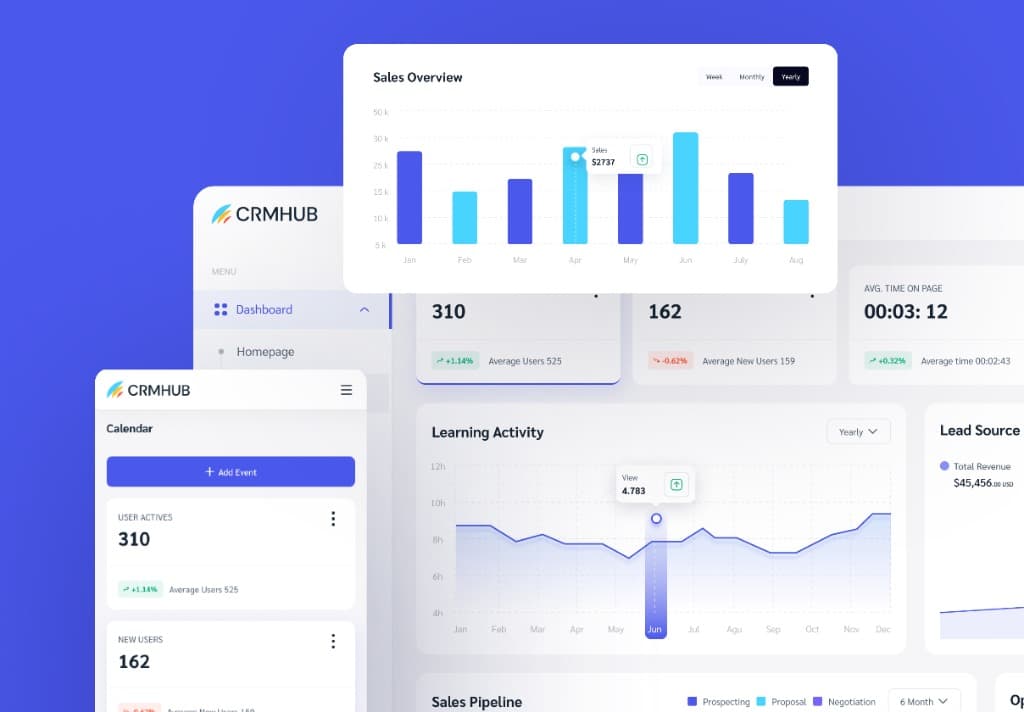
AI-Powered Customer CRM & Lead Tracker
Full-featured CRM system built with Python, Django ORM, PostgreSQL database, and OpenAI summary generation.
- Customer contact & automated lead management pipeline
- Automated AI summary insights and email notifications
- Role-based access control (RBAC) and JWT authentication
- PostgreSQL database with indexed search & query optimization
Real-Time Financial & Stock Analytics Engine
Multi-threaded market tracking system capable of handling real-time price feeds, analytical metrics, and webhooks.
- Real-time price feed polling and WebSocket stream delivery
- In-memory caching with Redis for sub-millisecond retrieval
- Historical trend computations and statistical aggregations
- Asynchronous task queuing for alert triggers & notifications
Enterprise Order & Inventory Engine
Full-stack e-commerce transaction and inventory engine with database locking, cart checkout, and payment gateway simulation.
- ACID database transaction locks for race-condition prevention
- Celery asynchronous worker processes for invoice PDF generation
- Complete REST API backend with swagger documentation
- Production deployment using Docker Compose and Gunicorn
Build Your Own Production-Style Python Application
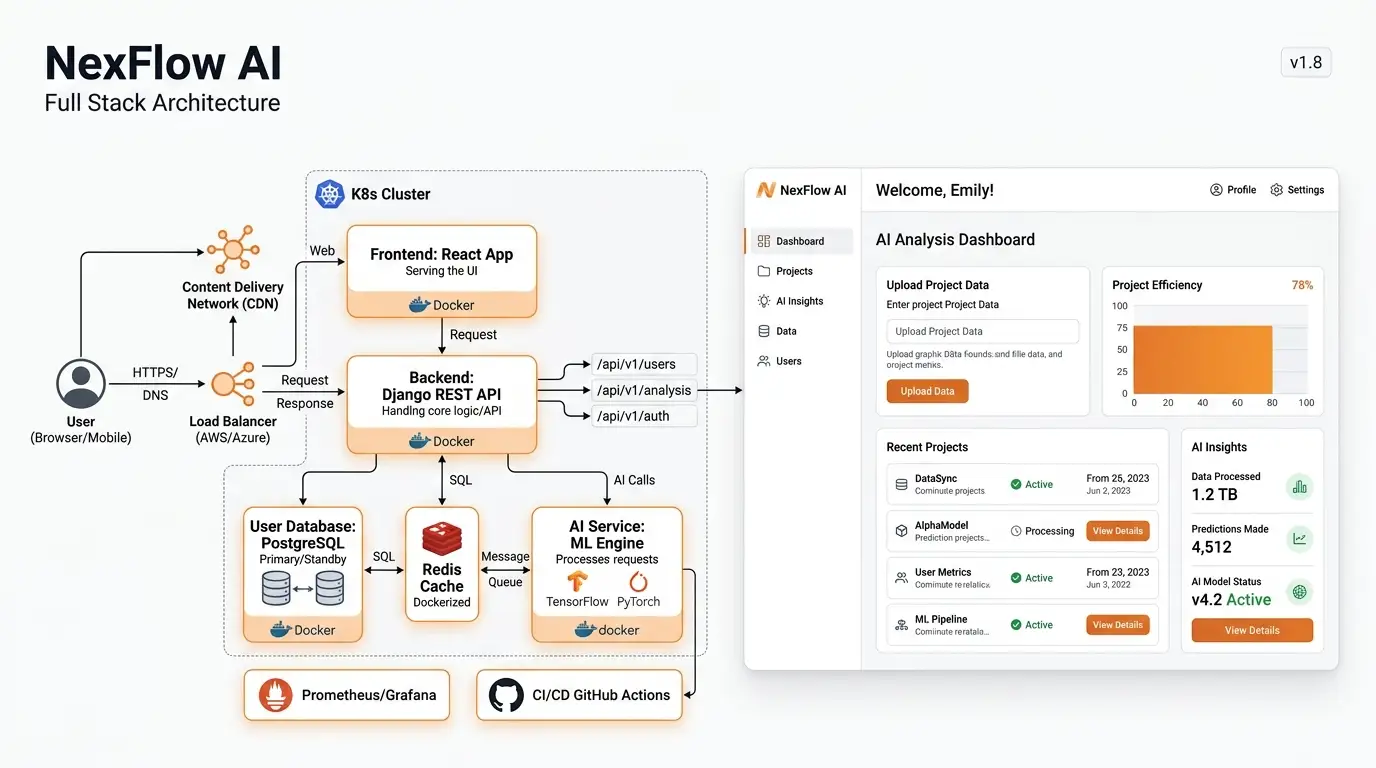
Take everything you learned and build a complete application from: Requirement → Python Logic → Database Schema → REST API → Authentication → Deployment.
YOUR FINAL PORTFOLIO CAN INCLUDE:
What You Get Beyond Technical Training
We Don't Stop at the Last Class.
Learning to code is only one part of becoming interview-ready. Your career preparation includes:
01 — Resume Preparation
01 — Resume Preparation
Create a developer-focused resume highlighting your technical skills and projects.
Why AIDEAS Academy?
Learn. Build. Prepare. Get Career Support.
Designed from the ground up for career switchers, fresh graduates, and ambitious engineers seeking practical, production-grade technical skills.
Industry-Oriented Curriculum
Learn technologies and workflows used in modern software development.
Hands-On Learning
Apply concepts by building applications instead of only watching demonstrations.
Live + Recorded Learning
Attend live sessions and use recordings for revision.
Beginner-Friendly Approach
Start from programming fundamentals and progress toward advanced development.
Real-World Projects
Build portfolio-oriented applications based on practical development scenarios.
Career Preparation
Resume guidance, mock interviews, technical preparation and placement assistance.
Expert Guidance
Learn with trainers and mentors focused on practical development skills.
A Complete Python Developer Stack
Our syllabus covers all foundational and advanced tiers of modern Python engineering
CORE & OOP
WEB FRAMEWORKS
DATABASE
WEB SERVICES & APIS
DEVOPS & AUTOMATION
GENAI & AGENTS
What Roles Can You Target After This Course?
Python skills unlock diverse engineering opportunities
Python skills unlock diverse engineering opportunities across backend, web development, data, and automation
The actual role and compensation you qualify for will depend on your skills, projects, experience, interview performance and the employer.
Is This Course Right For You?
You Can Start Even If You Are Starting From Zero.
This Program Is Suitable For:
- ✓B.Tech, BCA, MCA, B.Sc graduates
- ✓Non-IT graduates looking to transition to software
- ✓Freshers seeking their first software developer job
- ✓Working professionals aiming to upskill to Python & Django
You Don't Need:
- ✕Any prior programming knowledge
- ✕Advanced mathematics background
- ✕Prior IT or computer science degree
- ✕Experience with complex web frameworks
You Do Need:
- ✓A laptop or PC with internet connection
- ✓Dedication to practice 1-2 hours daily
- ✓Willingness to write code and solve problems
- ✓Commitment to attend live classes and complete labs
Your 9-Step Python Developer Roadmap
Progress from fundamentals to production code and verified interview readiness.
Zero to Production-Ready Python Developer
Continuous 9-stage roadmap spanning Python fundamentals, web frameworks, APIs, deployment, and career launch.
IT & Programming Basics
SDLC, Git, Python setup, variables, and control flow.
Data Structures & Functions
Lists, dicts, tuples, sets, functions, lambdas, and modules.
OOP & Exception Handling
Classes, inheritance, polymorphism, and try/except persistence.
Relational SQL & PostgreSQL
Database schemas, queries, joins, and Python DB connections.
Web Basics & Flask
Client-server HTTP, routing, Jinja2 templates, and lightweight APIs.
Django Web Framework
Full-scale MVT architecture, models, ORM, views, forms, and auth.
REST APIs with DRF
Serializers, ViewSets, JWT authentication, and Postman testing.
Docker & Cloud Deployment
Containerization, environment vars, Gunicorn, and cloud hosting.
GenAI APIs & Interviews
OpenAI integration, portfolio curation, and mock interviews.
Qualify for In-Demand Developer Opportunities
Connect with our network of 150+ hiring partners across Hyderabad & PAN India, participate in technical mock interviews, and graduate with a verified live project portfolio.
AIDEAS Academy By The Numbers
See What Our Students Say
Real Students. Real Learning Experiences.
Arjun Mehta
Python Full Stack • Batch 2024
“I shifted from manual testing to Python development. The Django and REST API modules are very detailed. I built a complete E-commerce site which impressed my interviewers.”
Priya Sharma
Deloitte“The combination of Python, SQL, and AWS in this course is perfect for Data Engineering roles. I use the concepts I learned here every single day at my job.”
“FastAPI coverage was excellent. I learned how to build high-performance APIs and handle async requests. The mock interviews helped me refine my technical answers.”
Vishal Singh
Backend Developer @ Zoho
“I had zero coding knowledge. They started with basic Python and took us to advanced frameworks. The mentorship and code reviews were very helpful.”
Neha Patel
Software Developer • IBM
Arjun Mehta
Python Full Stack • Batch 2024
“I shifted from manual testing to Python development. The Django and REST API modules are very detailed. I built a complete E-commerce site which impressed my interviewers.”
Priya Sharma
Deloitte“The combination of Python, SQL, and AWS in this course is perfect for Data Engineering roles. I use the concepts I learned here every single day at my job.”
“FastAPI coverage was excellent. I learned how to build high-performance APIs and handle async requests. The mock interviews helped me refine my technical answers.”
Vishal Singh
Backend Developer @ Zoho
“I had zero coding knowledge. They started with basic Python and took us to advanced frameworks. The mentorship and code reviews were very helpful.”
Neha Patel
Software Developer • IBM
“Coming from a Civil Engineering background, I was intimidated by programming. The hands-on coding assignments and daily doubt support at AIDEAS made full stack logic intuitive.”
Ravi Kumar
Full Stack Engineer @ TCS
“The Docker and AWS deployment module is a game-changer. Interviewers were surprised that I knew about microservices, CI/CD, and containerization at a fresher level.”
Sneha Reddy
Cloud Backend Engineer • Infosys
Sai Krishna
Python Full Stack Career Track • Batch 2024
“Placement support is 100% genuine. They helped me with my resume, conducted 5 mock interviews, and referred me directly. I had multiple offers in hand.”
Ananya Gupta
HCL Tech“The project-based learning is what sets them apart. We built a real CRM system and analytics engine, not just a Todo list. That portfolio alone got me shortlisted everywhere.”
“Coming from a Civil Engineering background, I was intimidated by programming. The hands-on coding assignments and daily doubt support at AIDEAS made full stack logic intuitive.”
Ravi Kumar
Full Stack Engineer @ TCS
“The Docker and AWS deployment module is a game-changer. Interviewers were surprised that I knew about microservices, CI/CD, and containerization at a fresher level.”
Sneha Reddy
Cloud Backend Engineer • Infosys
Sai Krishna
Python Full Stack Career Track • Batch 2024
“Placement support is 100% genuine. They helped me with my resume, conducted 5 mock interviews, and referred me directly. I had multiple offers in hand.”
Ananya Gupta
HCL Tech“The project-based learning is what sets them apart. We built a real CRM system and analytics engine, not just a Todo list. That portfolio alone got me shortlisted everywhere.”
What Makes Our Python Program Different?
Most Courses Teach Technologies. We Focus on the Complete Journey.
Learn
Understand the concepts from the foundation.
Practice
Solve coding problems and work through guided exercises.
Build
Create real applications using the technologies you learn.
Deploy
Learn how applications are prepared and deployed.
Prepare
Build your resume, GitHub profile and interview skills.
Apply
Get career guidance and placement assistance.
Attend a Live Python Demo Session
Experience our mentor-led teaching style firsthand.
Don't decide based on a brochure.
Attend a Free Demo Session.
In the demo, discover:
No obligation. Speak with a course counsellor and understand the program first.
Frequently Asked Questions
Everything you need to know about our Python Training Program in Hyderabad
This course is crafted for complete beginners, college students, career changers, and working professionals who want to master Python programming, web development (Django/Flask), databases, APIs, and modern AI integration. No prior programming background is required.
This Python Course focuses extensively on Core Python, Object-Oriented Programming, Data Structures, Database Systems (SQL & PostgreSQL), Web Frameworks (Flask & Django), REST APIs, and AI integrations. The Python Full Stack course covers both this complete Python backend stack plus the dedicated frontend stack (HTML, CSS, modern JavaScript, and React JS).
You will build 3+ production-grade enterprise projects including an AI-Powered Customer Management & CRM system, a Real-Time Stock & Financial Market Tracker, and an Enterprise E-Commerce Order & Inventory Engine with PostgreSQL and REST APIs.
You get live interactive classes with senior industry mentors, accompanied by lifetime access to HD class recordings, source code repositories, practice assignments, and 1:1 doubt-clearing sessions.
Yes! AIDEAS Academy provides 100% dedicated placement assistance including developer resume review, GitHub portfolio curation, technical mock interviews, soft skills training, and direct interview scheduling with our 500+ hiring network partners.
Yes. Upon completing the course modules and your live capstone project, you will receive a verifiable industry certification from AIDEAS Academy that you can showcase on LinkedIn and your resume.
Your Next Step Is Simple
Don't Spend Months Watching Random YouTube Tutorials.
Python Syntax → Data Structures → OOP Principles → SQL & PostgreSQL → Flask & Django → REST APIs → Docker Deployment → Interview Preparation
Start Your Python Developer Career Journey With AIDEAS Academy
Learn the core craft. Build production systems. Prepare for enterprise opportunities.