AI & ML
TRAINING + PLACEMENTS
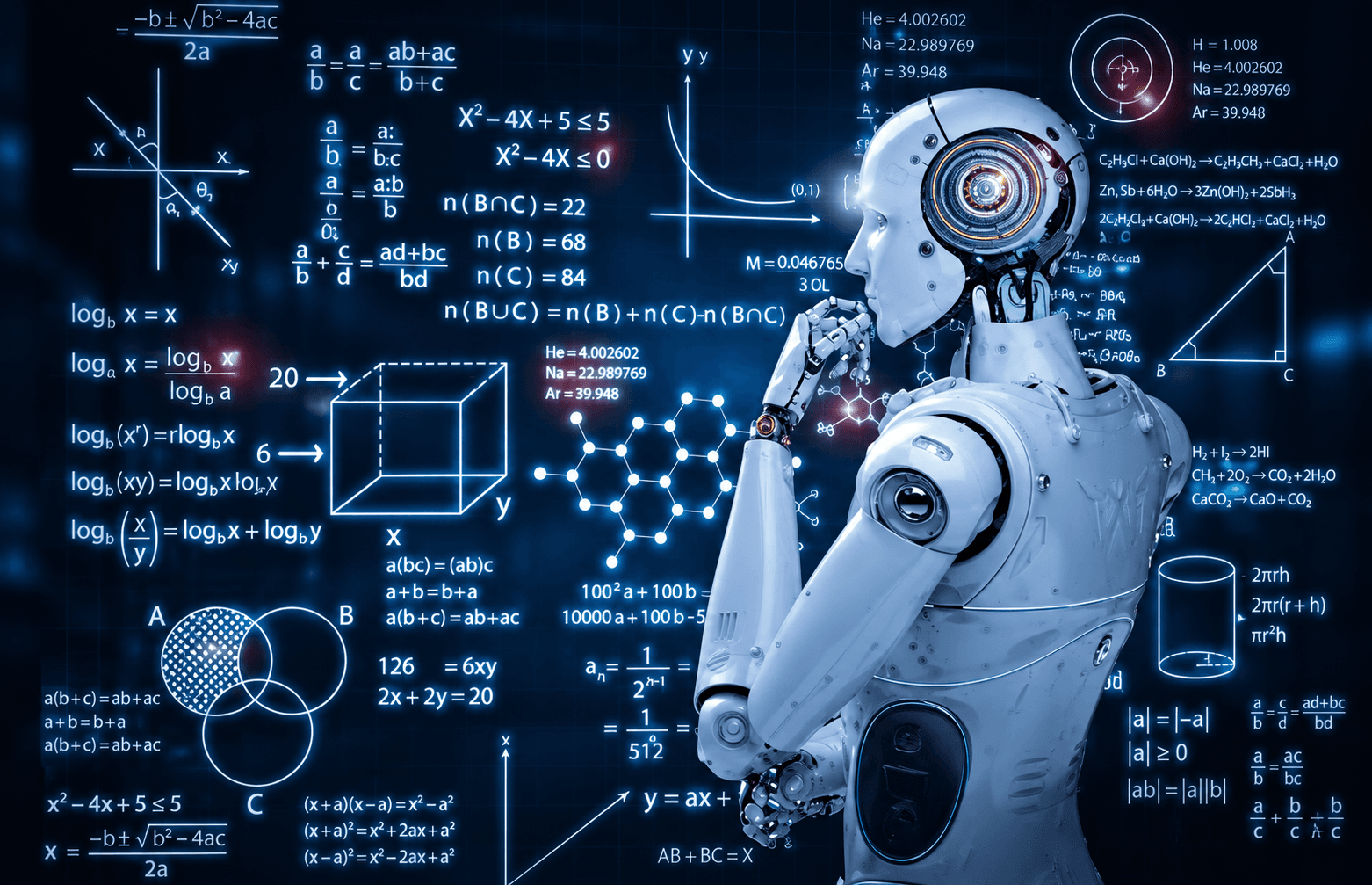
Master Python, machine learning, deep learning, NLP, and LLM application development.
Our Alumini Work At
















Why Learn AI & ML in 2026?
Don't Learn Just Models. Learn How to Build Intelligent Products.
Knowing a model architecture is only the beginning.
Companies need engineers who can take data from preparation and modelling through to deployment, and who can integrate modern LLMs and AI APIs into real products.
Our AI & ML program takes you from Python and statistics to machine learning, deep learning, NLP and generative AI, with hands-on projects along the way.
Statistical Learning + Deep Neural Networks + NLP & Transformers + Production MLOps Deployment.
Complete AI & ML Stack

Python
Build a strong programming foundation for data and AI.

NumPy & Pandas
Prepare, clean and analyse real datasets.

Scikit-learn
Build, tune and evaluate classical ML models.

TensorFlow
Train neural networks for vision and language tasks.

PyTorch
Build and experiment with modern deep learning models.

NLP & LLMs
Work with text models, transformers and pretrained LLMs.

OpenAI APIs
Integrate AI APIs into modern applications and AI agents.

MLOps
Learn how models move from experiments to production.
Want to See the Complete Roadmap?
Get the AI & ML Syllabus
The AI & ML Curriculum
- Introduction to SDLC and its importance
- SDLC phases
- Requirement gathering and analysis
- System design
- Development
- Testing
- Deployment
- Maintenance and support
- Waterfall model
- Agile methodology
- Scrum framework overview
- DevOps lifecycle basics
- Waterfall methodology overview
- Agile principles and values
- Scrum roles, ceremonies, and artifacts
- Kanban basics
- Continuous Integration and Continuous Delivery (CI/CD)
- Version control and collaborative development practices
- Business Analyst
- UI/UX Designer
- Data Analyst
- Data Scientist
- Machine Learning Engineer
- Backend Developer
- QA / Software Tester
- DevOps Engineer
- Project Manager / Scrum Master
- Product Owner
- What is Data Science
- Why Data Science
- Impact of Data Science
- Future of Data Science
- Business understanding
- Data collection
- Data preprocessing
- Model building
- Evaluation
- Deployment and monitoring
- Introduction to Pre-Core Python
- Introduction to Jupyter Notebook
- Overview of real-time Data Science IDEs
- Introduction to Google Colaboratory
- Introduction to UNIX Operating System
- Python introduction and environment setup
- Software required to learn Python
- Variables and identifiers
- Data types (Boolean, Integer, Complex)
- Python collections
- Type casting
- Control statements
- Data structures: Lists and Arrays
- Conditions and branching
- Functions and methods
- Exception handling
- File handling
- Object-Oriented Programming concepts
- Advanced Python coding
- Python Database Connectivity (PDBC)
- Practice problems and reviews
- Live application implementation
- NumPy
- Pandas
- Matplotlib
- Seaborn
- SciPy
- Pillow
- TensorFlow
- Data visualization principles
- Basic plotting techniques
- Data manipulation for visualization
- One-dimensional data analysis
- Histograms
- Boxplots
- Violin plots
- Introduction to Power BI
- Data extraction process
- Data transformations
- Data modeling and DAX
- Analytical dashboards and visualizations
- Basics of statistics
- Types of statistics
- Population and sample
- Measures of central tendency
- Percentiles and dispersion
- Range
- Sample variance
- Standard deviation
- Correlation and causation
- Hypothesis testing concepts
- Parametric tests
- Non-parametric tests
- What is probability
- Importance of probability in ML
- Random variables
- Probability distributions
- Maximum likelihood estimation
- Bayes theorem
- Information theory
- Cross entropy
- Information gain
- Scalars and vectors
- Vector addition and subtraction
- Scalar multiplication
- Dot product
- Cross product
- Scalars, vectors, and matrices
- Types of matrices
- Matrix transpose
- Matrix addition and subtraction
- Eigenvalues and eigenvectors
- Introduction to data structures
- Big O notation and time complexity
- Arrays (static vs dynamic)
- Linked lists and doubly linked lists
- Hash tables and hash maps
- Collision handling and chaining
- Stack implementation
- Queue implementation
- Trees and binary trees
- Binary search trees
- Graph fundamentals
- Linear search
- Binary search
- Sorting algorithms
- Bubble sort
- Quick sort
- Insertion sort
- Merge sort
- Shell sort
- Recursion concepts
- Recursion implementation in Python
- What is Machine Learning
- Types of Machine Learning
- Supervised Learning
- Unsupervised Learning
- Types of data: continuous and categorical
- Data exploration and visualization
- Inferential statistics
- Data distributions
- Correlation and covariance
- Handling missing values
- Scatter plots and heatmaps
- Data normalization techniques
- Data imputation techniques
- Introduction to regression
- Simple linear regression
- Multiple linear regression
- Linear regression assumptions
- Regularization techniques
- Lasso regression
- Ridge regression
- Elastic Net regression
- Polynomial regression
- Stepwise regression
- R-squared and adjusted R-squared
- Introduction to classification
- Types of classifiers
- Linear classifiers
- Logistic regression
- Multinomial logistic regression
- Decision trees
- CART algorithm
- ID3 algorithm
- Random forests
- Support Vector Machines (SVM)
- Kernel trick
- Soft margin SVM
- Multi-class SVM
- Naive Bayes
- Neural networks for classification
- Perceptron algorithm
- Multilayer perceptron
- Backpropagation algorithm
- Activation functions
- Feature selection techniques
- Hyperparameter tuning
- Model selection techniques
- Bias–variance tradeoff
- Cross-validation
- Leave-one-out cross validation
- Ensemble methods
- Bagging algorithms
- Boosting algorithms
- XGBoost
- Gradient Boosting
- LightGBM
- CatBoost
- AdaBoost
- Stacking technique
- Blending technique
- Introduction to clustering
- K-means clustering
- Hierarchical clustering
- Principal Component Analysis (PCA)
- Singular Value Decomposition (SVD)
- Truncated SVD
- t-SNE
- Linear Discriminant Analysis (LDA)
- Introduction to deep learning
- Difference between ML and Deep Learning
- Biological neural networks
- Deep learning applications
- Artificial Neural Networks (ANN)
- Convolutional Neural Networks (CNN)
- Recurrent Neural Networks (RNN)
- CNN architecture
- Image preprocessing with OpenCV
- Image classification case study
- Transfer learning case study
- Introduction to text processing
- Text preprocessing using NLTK and SpaCy
- Vectorization techniques
- Recurrent Neural Networks
- LSTMs
- Autoencoders
- Text classification
- Sequence tagging
- Understanding Generative AI
- Applications of Generative AI
- Types of generative models
- GANs
- VAEs
- Autoregressive models
- Introduction to LLMs
- Transformer architecture
- Open-source LLMs
- Hugging Face and pretrained models
- Limitations of LLMs
- Advantages and disadvantages of LLM architectures
- Accessing open-source LLMs
- Responsible AI development practices
- What is prompt engineering
- Principles of prompt engineering
- Importance of prompt engineering
- Prompt engineering tools
- Prompt design strategies
- Types of prompting
- Writing effective prompts
- Best practices for prompt creation
- Parameter tuning
- Overview of AI APIs
- Authentication mechanisms
- Text generation workflows
- Image generation concepts
- Chat-based AI applications
- Definition of AI agents
- Autonomous agents vs chatbots
- Tool calling and function calling
- Agent workflows and orchestration
- AI and frontend integration concepts
- AI-driven user interfaces
- AI-assisted form interactions
- Frontend and AI communication patterns
- AI safety considerations
- Bias and fairness
- Data privacy and compliance
- Responsible AI usage
Don't Just Watch Classes. Build Applications.
Build Projects That You Can Actually Show in an Interview.
Your portfolio should demonstrate what you can build — not just what you studied.
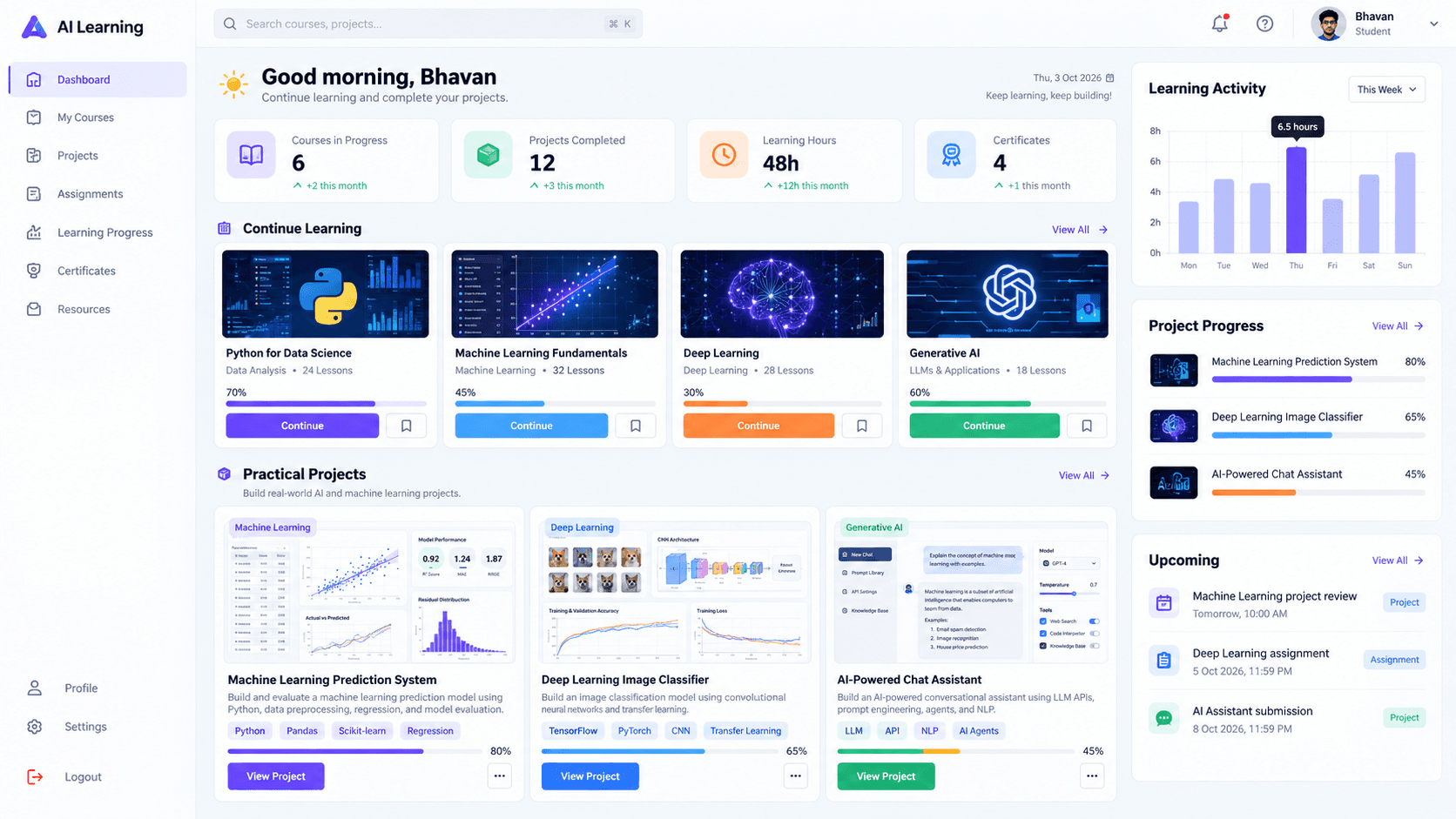
Machine Learning Prediction System
Build an end-to-end prediction model using Python, Pandas and Scikit-learn, from raw data to evaluated results.
- Data cleaning with missing-value imputation and normalization
- Linear, logistic and tree-based models compared side by side
- Cross-validation and hyperparameter tuning
- Model evaluation with precision, recall and ROC curves
Deep Learning Image Classifier
Train a convolutional neural network for image classification and apply transfer learning to a pretrained model.
- Image preprocessing and augmentation with OpenCV
- CNN architecture built and trained in TensorFlow and PyTorch
- Transfer learning from a pretrained network
- Training curves to diagnose overfitting
AI-Powered Chat Assistant
Build a chat application on top of LLM APIs with prompt engineering, tool calling and NLP-based text processing.
- Chat-based interface powered by an LLM API
- Structured prompts and parameter tuning
- Tool and function calling for agent-style workflows
- Text classification with an NLP pipeline and responsible-AI safeguards
Build Your Own Production-Style AI Application
Take everything you learned and build a complete AI application from: Requirement → Data → Model → Evaluation → API → Interface → Deployment
YOUR FINAL PORTFOLIO CAN INCLUDE:
What You Get Beyond Technical Training
We Don't Stop at the Last Class.
Learning to code and train models is only one part of becoming interview-ready. Your career preparation includes:
01 — Resume Preparation
01 — Resume Preparation
Create a developer-focused resume highlighting your technical skills and projects.
Why AIDEAS Academy?
Learn. Build. Prepare. Get Career Support.
Designed from the ground up for career switchers, fresh graduates, and ambitious engineers seeking practical, production-grade artificial intelligence and machine learning skills.
Industry-Oriented Curriculum
Learn technologies and workflows used in modern software development and production AI systems.
Hands-On Learning
Apply concepts by building applications and training models instead of only watching demonstrations.
Live + Recorded Learning
Attend live sessions and use recordings for revision whenever you need them.
Beginner-Friendly Approach
Start from programming fundamentals and progress toward advanced machine learning and deep learning.
Real-World Projects
Build portfolio-oriented applications based on practical AI development and production deployment scenarios.
Career Preparation
Resume guidance, mock interviews, technical preparation and placement assistance.
Expert Guidance
Learn with trainers and mentors focused on practical machine learning and AI engineering skills.
A Complete AI & ML Developer Stack
Work with industry-standard libraries, frameworks, cloud platforms and AI APIs.
PROGRAMMING
MACHINE LEARNING
DEEP LEARNING
NLP & LLMs
DEPLOYMENT & MLOPS
AI APIs & AGENTS
What Can You Do After Learning AI & ML?
Explore Multiple Technology Career Paths
Your AI & ML skills can prepare you for roles such as:
The actual role and compensation you qualify for will depend on your skills, projects, experience, interview performance and the employer.
Is This Course Right For You?
You Can Start Even If You Are Starting From Zero.
Suitable For
You Don't Need
You Do Need
Your AI & ML Career Roadmap
Progress from Python and statistics to deployed models, LLMs, and verified interview readiness.
Zero to Job-Ready AI Engineer
Continuous 9-stage roadmap spanning Python, statistics, machine learning, deep learning, LLMs, and career launch.
Learn Python
Core syntax, data structures, OOP principles, and mathematical problem-solving in Python.
Learn Statistics & Math
Probability theory, hypothesis testing, matrix operations, calculus, and exploratory data analysis.
Master Machine Learning
Supervised and unsupervised models, decision trees, random forests, XGBoost, and model evaluation.
Learn Deep Learning
Multi-layer perceptrons, convolutional neural networks (CNNs), RNNs, transfer learning, and computer vision.
Work With NLP & LLMs
Tokenization, word embeddings, transformer architectures, Hugging Face pipelines, and prompt engineering.
Build AI Projects
Vector databases, RAG pipelines, OpenAI function calling, autonomous AI agents, and custom chat interfaces.
Deploy Models
FastAPI endpoints, containerization with Docker, model registries, CI/CD, and cloud hosting.
Prepare for Interviews
Coding assessments, ML system design walkthroughs, theoretical drills, and 1-on-1 mock interviews.
Start Applying for AI Opportunities
Active referral distribution across hiring partners in Hyderabad & PAN India, and continuous placement support.
Qualify for In-Demand AI & ML Opportunities
Connect with our network of 150+ hiring partners across Hyderabad & PAN India, participate in technical mock interviews, and graduate with a verified live project portfolio.
AIDEAS Academy By The Numbers
See What Our Students Say
Real Students. Real Learning Experiences.
“Building full-pipeline models from Scikit-learn to PyTorch and deploying with Docker gave me an immense advantage in interviews.”
“The deep dive into RAG pipelines, LangChain, and OpenAI API function calling was exactly what top tech companies look for.”
“Coming from non-CS, learning CNN architectures and OpenCV image preprocessing step-by-step made mastering deep learning effortless.”
“Building full-pipeline models from Scikit-learn to PyTorch and deploying with Docker gave me an immense advantage in interviews.”
“The deep dive into RAG pipelines, LangChain, and OpenAI API function calling was exactly what top tech companies look for.”
“Coming from non-CS, learning CNN architectures and OpenCV image preprocessing step-by-step made mastering deep learning effortless.”
“The hands-on transformer and Hugging Face modules gave me the confidence to answer every challenging NLP architecture question.”
“The capstone project gave me a real production blueprint to showcase. The recruiters were thoroughly impressed.”
“Mentors took extra time to review my code, refine my GitHub portfolio, and prepare me for technical mock rounds.”
“The hands-on transformer and Hugging Face modules gave me the confidence to answer every challenging NLP architecture question.”
“The capstone project gave me a real production blueprint to showcase. The recruiters were thoroughly impressed.”
“Mentors took extra time to review my code, refine my GitHub portfolio, and prepare me for technical mock rounds.”
“AIDEAS provided dedicated mock interviews that covered everything from loss functions to real-time model tuning.”
“Transitioned from business analysis into data science within 5 months. The structured curriculum made all the difference.”
“Docker, CI/CD, and model registry concepts are taught practically with working endpoints, not just theoretical slides.”
“AIDEAS provided dedicated mock interviews that covered everything from loss functions to real-time model tuning.”
“Transitioned from business analysis into data science within 5 months. The structured curriculum made all the difference.”
“Docker, CI/CD, and model registry concepts are taught practically with working endpoints, not just theoretical slides.”
“Prompt engineering, embeddings, and vector similarity search were taught with real enterprise datasets.”
“From Python syntax to deploying models on cloud endpoints, the progression is completely career-oriented.”
“The statistical learning foundation gave me deep clarity into algorithm selection and hyperparameter optimization.”
“Prompt engineering, embeddings, and vector similarity search were taught with real enterprise datasets.”
“From Python syntax to deploying models on cloud endpoints, the progression is completely career-oriented.”
“The statistical learning foundation gave me deep clarity into algorithm selection and hyperparameter optimization.”
“The 1:1 mentorship and architecture drills prepared me for high-bar technical interviews at global financial firms.”
“Built an end-to-end customer support AI agent with function calling that directly matched Swiggy's product requirements.”
“Hands-on projects and interview drills helped me stand out from hundreds of applicants during campus hiring.”
“The 1:1 mentorship and architecture drills prepared me for high-bar technical interviews at global financial firms.”
“Built an end-to-end customer support AI agent with function calling that directly matched Swiggy's product requirements.”
“Hands-on projects and interview drills helped me stand out from hundreds of applicants during campus hiring.”
What Makes Our AI & ML Program Different?
Most Courses Teach Technologies. We Focus on the Complete Journey.
Learn
Understand the concepts from the foundation.
Practice
Solve coding problems and work through guided exercises.
Build
Create real applications using the technologies you learn.
Deploy
Learn how applications are prepared and deployed.
Prepare
Build your resume, GitHub profile and interview skills.
Apply
Get career guidance and placement assistance.
FREE AI & ML DEMO CLASS
Not Sure If AI & ML Is Right for You?
Don't decide based on a brochure.
Attend a Free Demo Session.
In the demo, discover:
Frequently Asked Questions
Everything you need to know about the curriculum, eligibility, projects, and admissions.
Your Next Step Is Simple
Don't Spend Months Learning Random Tutorials.
Python → Statistics → Machine Learning → Deep Learning → NLP & LLMs → Deployment → Projects → Interview Preparation
Start Your AI & ML Journey With AIDEAS Academy
Learn the skills. Build the projects. Prepare for the opportunities.